State of EU and French Sanctions Relating to Israeli Settlements
On 27 October 2026, Israelis will elect the 26th Knesset. This election provides an opportunity to take a look at the restrictive measures adopted by the European Union and by France in connection with the situation in the West Bank.
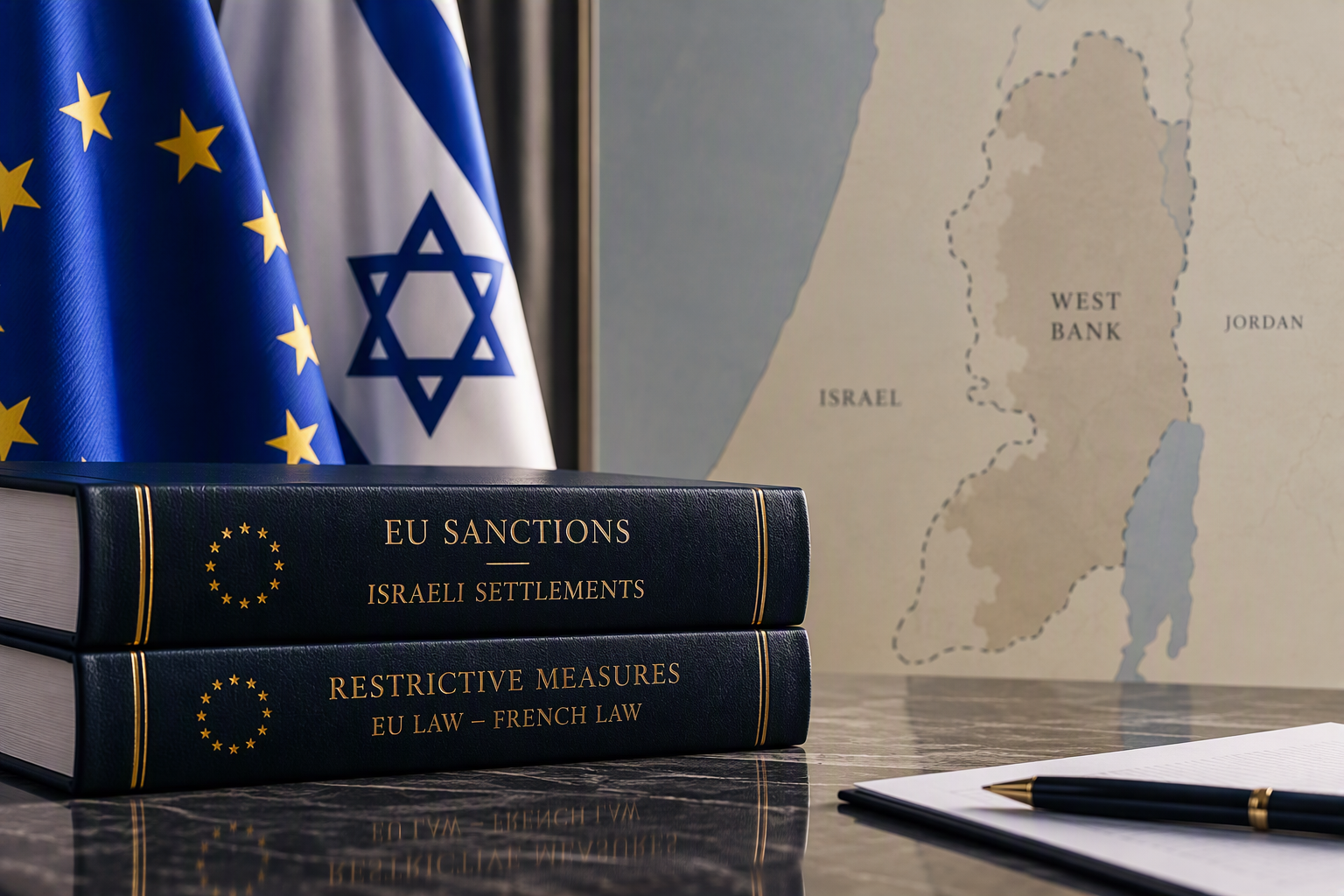
On 27 October 2026, Israeli voters will go to the polls for the first time since the attacks of 7 October 2023. The future of the West Bank and of its settlements are among the themes of this campaign.
In Europe, this issue has given rise in recent months to a series of unprecedented decisions and announcements. In particular, several States, including France, have announced their intention to ban products originating from the settlements.
On the occasion of this election, this overview successively examines the individual sanctions adopted at EU level, the regime applicable to settlement products, and the measures taken by France and how they interact with EU law.
Individual Sanctions Adopted at European Union Level
The EU Global Human Rights Sanctions Regime as the Basis of the Framework
The Union does not have a sanctions regime targeting Israel or the West Bank as such. It has instead chosen to act within a broader framework, namely the EU Global Human Rights Sanctions Regime, established by Council Decision (CFSP) 2020/1999 of 7 December 2020.
This regime was first used to sanction direct perpetrators of violence in the region. On 19 April 2024, the Council listed four individuals and two entities under its provisions, including the supremacist organisation Lehava and the Hilltop Youth group, for serious abuses of Palestinians’ rights in the West Bank.
Three months later, on 15 July 2024, a second round of listings broadened the scope of the measures. It targeted several settlers living in unauthorised outposts, as well as the Tzav 9 group for attacks on humanitarian convoys bound for Gaza.
It then took almost two years for a third set of measures to be adopted. Under EU law, such a foreign policy measure requires unanimity, and Hungary long exercised its veto under Viktor Orbán. With Péter Magyar’s accession to power, this obstacle was overcome.
These new listings adopted on 28 May 2026 target a new category of individuals and entities. The aim is no longer only to sanction perpetrators of violence, but also the structures that organise, finance or support settlement expansion. The following were thus listed:
- The Nachala movement and its director, Daniella Weiss;
- The NGO Regavim and its director, Meir Deutsch;
- The Hashomer Yosh association and its chairman, Avichai Suissa;
- The Amana cooperative, described as having contributed to the establishment of at least thirty violent outposts and settlements.
The legal effects of these listings are similar to those of a conventional sanctions regime, such as the one adopted in connection with the Russia-Ukraine conflict. In particular, the listed persons and entities are subject to an asset freeze, and it is prohibited to make funds or economic resources available to them, directly or indirectly. Natural persons are also subject to a ban on entering the territory of the Union.
Measures Still Pending
In September 2025, however, the Commission had tried to put forward a more ambitious set of measures. It included, in particular, sanctions against Israeli ministers Itamar Ben-Gvir and Bezalel Smotrich, as well as the suspension of the trade-related provisions of the EU-Israel Association Agreement.
As regards the two ministers, unanimity is still lacking, Czechia having made it known that it would oppose any such proposal before the outcome of the Israeli elections.
The suspension of the trade component of the Association Agreement is even more noteworthy. It was based on an alleged breach of Article 2 of the Agreement, which makes respect for human rights one of its essential elements. Although such a suspension only requires a qualified majority, the opposition of Germany and Italy was nevertheless enough to bring the proposal to a halt in April 2026.
At EU level, sanctions therefore target individuals and organisations but does not reach neither the State of Israel nor its trade with the Union. The debate has in fact shifted to the treatment of products originating from Israeli settlements.
Settlement Products being Subject to a Differentiation Regime
An EU Regime Based on Differentiation Rather than Prohibition
Under EU law as it currently stands, products originating from Israeli settlements are not banned from the EU market. They are subject to differentiated treatment, based on two complementary mechanisms.
The first is customs-related. These products are excluded from the tariff preferences granted to Israeli goods under the Association Agreement. To identify them, customs authorities rely on a list of postal codes annexed to Notice to importers 2012/C 232/03.
The second concerns consumer information. Since a landmark 2019 judgment of the Court of Justice, foodstuffs originating from a settlement must explicitly indicate that provenance.
This regime therefore does not close the EU market to settlement products; it merely denies them the treatment reserved for Israeli products and ensures their traceability.
The Debate on an EU-Wide Ban
It is this framework that several Member States are now seeking to move overtake. At their request, the Commission circulated an options paper on 9 July 2026 setting out three possible approaches:
- An import licensing regime;
- Prohibitive customs duties;
- A total or partial import ban.
At the Foreign Affairs Council of 13 July 2026, the ban option attracted the most support, although no option secured a clear majority.
The debate, however, comes up against a preliminary question, namely the legal basis for such a measure. The answer determines the voting rule, and therefore whether the project can succeed at all:
- The Commission considers that such a measure falls within the Common Foreign and Security Policy and therefore requires unanimity.
- The Council Legal Service considers that a measure based on the common commercial policy, under Article 207 TFEU, is conceivable. It could then be adopted by qualified majority.
In September, Kaja Kallas sided with this second interpretation and publicly supported an EU-wide ban. To date, however, no legislative proposal has been tabled.
French National Measures that Precede and Go Beyond EU Law
Measures Targeting Individuals
Without waiting for EU unanimity, France took measures against violent settlers as early as 2024. On 13 February 2024, twenty-eight of them were made subject to an administrative ban from French territory.
In 2026, these measures were extended to Itamar Ben-Gvir and Bezalel Smotrich, members of the Israeli government, as well as to four leaders of settler organisations and twenty-one violent settlers.
These national decisions, and their effects, must be distinguished from EU sanctions. They are administrative measures under immigration law, which prohibit entry into national territory but entail no asset freeze, since outside the cases provided for in the French Monetary and Financial Code (notably in relation to terrorism), French law does not provide for an autonomous freezing mechanism suited to such situations. The freezing of the sanctioned settlers’ assets therefore results solely from EU regulations, which are directly applicable in France.
Announcement of a Ban on Settlement Products
On 8 September 2026, the French Minister for Europe and Foreign Affairs, Jean-Noël Barrot, announced that France would initiate a procedure to ban products originating from the settlements. The announcement is part of a joint statement by twelve States, all of which undertake to introduce national restrictions or to support EU restrictions on these products, thereby going beyond the existing EU framework. Several Member States have in fact already taken this step, such as Ireland and the Netherlands.
The French government has stressed that this is not a boycott of the State of Israel, but a measure limited to goods produced in the settlements. To date, neither the legal act, nor the list of products concerned, nor the date of entry into force of such measures has yet been published.