The ICC Now Directly Targeted by US Sanctions
Having sanctioned, one by one, seventeen individuals connected to the International Criminal Court, Washington crossed an unprecedented threshold on 9 October 2026 by placing the Court itself on its blacklist. The measure is spectacular, but its actual reach is, for now, limited by a series of licences that the official rhetoric largely silences.
Designations initially limited to individuals
The US offensive against the Court located in the Hague started before this autumn. It is based on an executive order signed by Donald Trump on 6 February 2025, which allows sanctions to be imposed on any person who has directly engaged in an ICC investigation or prosecution of nationals of the United States or of allied States which did not ratify the Rome Statute, without the consent of those States. In this respect, Israel is quite clearly the mainly concerned State.
The first individual designated was Prosecutor Karim Khan, listed as early as 13 February 2025, after he had sought arrest warrants against Benjamin Netanyahu and Yoav Gallant, as well as against Hamas leaders.
His designation was followed by that of four judges later the same year. Two of them had authorised the investigation into the conduct of US military personnel in Afghanistan, and the other two had authorised the issuance of the arrest warrants against the aforementioned Israeli leaders.
The list then grew at a steady pace. In July 2025, Washington sanctioned Francesca Albanese, the UN Special Rapporteur on the Palestinian territories. In August, it was the turn of two other judges, including the French judge Nicolas Guillou, and of the two Deputy Prosecutors.
Three Palestinian NGOs, Al-Haq, Al Mezan and the Palestinian Centre for Human Rights, were designated in September. In December, two more judges were sanctioned a few days after the rejection of Israel’s appeal seeking to have the arrest warrants issued against Netanyahu and Gallant withdrawn. Finally, in August 2026, the sanctions reached the President of the Court herself, Tomoko Akane.
For each of these persons, the effects are those of a standard listing on the SDN List. Their assets within US jurisdiction are frozen, and all US persons are prohibited from providing them with funds, goods or services.
Only one of these designations has been successfully challenged before the US courts. In May 2026, a federal court in Washington suspended the application of Francesca Albanese’s designation, and OFAC confirmed that it would no longer be implemented for as long as that ruling remains in force.
The addition of the ICC to the SDN List
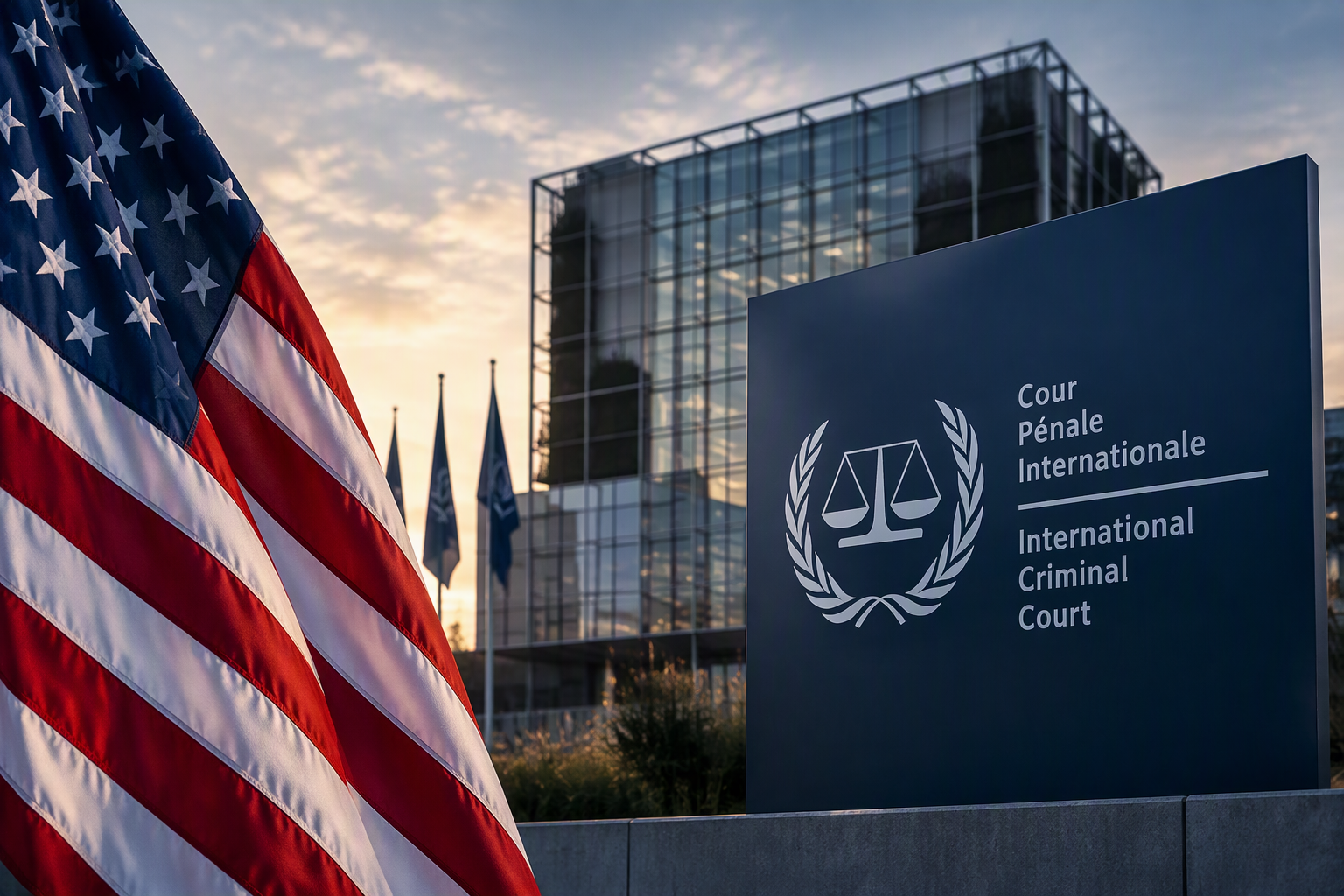
Until then, the Court had continued to operate while its members were being sanctioned. Its designation on 9 October, however, changes the picture. The targets are no longer just judges and prosecutors, but the institution itself, its accounts, its suppliers and its infrastructure. All ICC property within US jurisdiction is now blocked, and any transaction with the Court is, in principle, prohibited for US persons.
Marco Rubio’s tone leaves no room for nuance. The Secretary of State says he intends to cut off the Court’s resources and cripple its ability to function, going so far as to state that either the ICC ends its threats, or the United States will end the ICC. According to Le Monde, Washington is demanding in return the withdrawal of the warrants against Benjamin Netanyahu and Yoav Gallant, the abandonment of the Afghanistan investigation, and an amendment to the Statute barring any prosecution of nationals of non-party States.
The Court responded the same day, denouncing an unprecedented measure which, in its view, seeks to obstruct the course of justice and to intimidate those who cooperate with it.
Exceptions left unmentioned in the official rhetoric
The contrast between Marco Rubio’s statement and the texts published on the same day by the Treasury is striking. The Secretary of State makes no mention of any exception to the regime, whereas his own department’s fact sheet announces four general licences, adopted at the same time as the designation.
The most significant of these authorises, until 7 April 2027, all transactions necessary to maintain the Court’s activities. Its scope is very broad, as it covers contributions from States Parties, staff salaries and health coverage, rent, taxes, insurance and ordinary services. In other words, the Court can, for now, continue to operate almost normally. Washington makes no secret of this. This six-month period is intended to allow States Parties to demonstrate what it regards as meaningful progress, and the licence may be adjusted depending on the outcome of those efforts. The sanction is thus deferred, and serves as leverage in the negotiations.
The second licence authorises, with no time limit, telecommunications, online communication services and all transactions relating to the enterprise software used by the Court, from its supply to its maintenance. Here again, the notion is broadly construed, covering financial management, payroll, cybersecurity, data storage and cloud services. The stakes are considerable, since the Court’s digital infrastructure relies to a large extent on US providers. Without this exception, the designation could have deprived the Court, almost immediately, of its email systems, its servers and its management tools.
The last two licences are more narrowly targeted. One allows the payment of pensions, with a blocked-account mechanism where the beneficiary is themselves sanctioned. The other authorises the transactions necessary for the detention of persons held in The Hague, including services relating to their health and safety. Washington is thus careful not to jeopardise the detention of individuals prosecuted for the most serious crimes.
A Protection that does not extend to sanctioned individuals
The four licences described above protect the Court as an institution, but not the persons designated in their individual capacity. Each of them expressly excludes transactions involving any other person sanctioned under the same programme.
The consequence is very concrete. Among other things, a bank may pay salaries to ICC staff under the cover of the maintenance licence but may not do so where the beneficiary is a person designated in their individual capacity, a distinction that screening systems must take into account.
Europe and the Blocking Statute dilemma
The European response has remained cautious. On 10 October, the High Representative expressed, on behalf of the Union, his deep regret and called for the measures to be withdrawn. He nevertheless took note of the grace period granted, which he sees as leaving room for diplomacy.
The European Parliament is taking a more assertive line. In a letter sent to Ursula von der Leyen on 13 October, 58 MEPs called for the Blocking Statute to be activated before the grace period expires. They regard the measure as an attack on an institution established on European soil, carried out through the European financial system itself.
This Act dated 1996 prohibits European operators from complying with the extraterritorial sanctions it covers. It allows them to seek compensation and deprives foreign decisions based on those sanctions of any effect within the Union. To date, it has only been activated against certain measures targeting Cuba and Iran, and its effectiveness remains a matter of debate. Were it to be triggered, European banks and service providers could find themselves caught between a US prohibition on dealing with the Court and a European prohibition on complying with that very prohibition.
Six months to negotiate
At this stage, the designation of the ICC operates as much as an ultimatum as a sanction. The Court remains operational, its digital tools are preserved and its detainees continue to be cared for. But 7 April 2027 is a real deadline, one that Washington itself presents as open to revision in either direction. For European institutions exposed to US jurisdiction, whether through their use of the dollar, their correspondent banks or their technology providers, now is the time to map their relationships with the Court and to prepare for either scenario.