Legal Effects of the Controversial Renewal of the Russian Individual Restrictive Measures
On 22 September 2026 the Council of the European Union extended the individual restrictive measures adopted under the regime relating to the territorial integrity of Ukraine. It has been undergone for thirty-six instead of six, at the price of three delistings. Thereafter an analysis of a change of tempo whose effects reach far beyond the negotiation that made it possible.
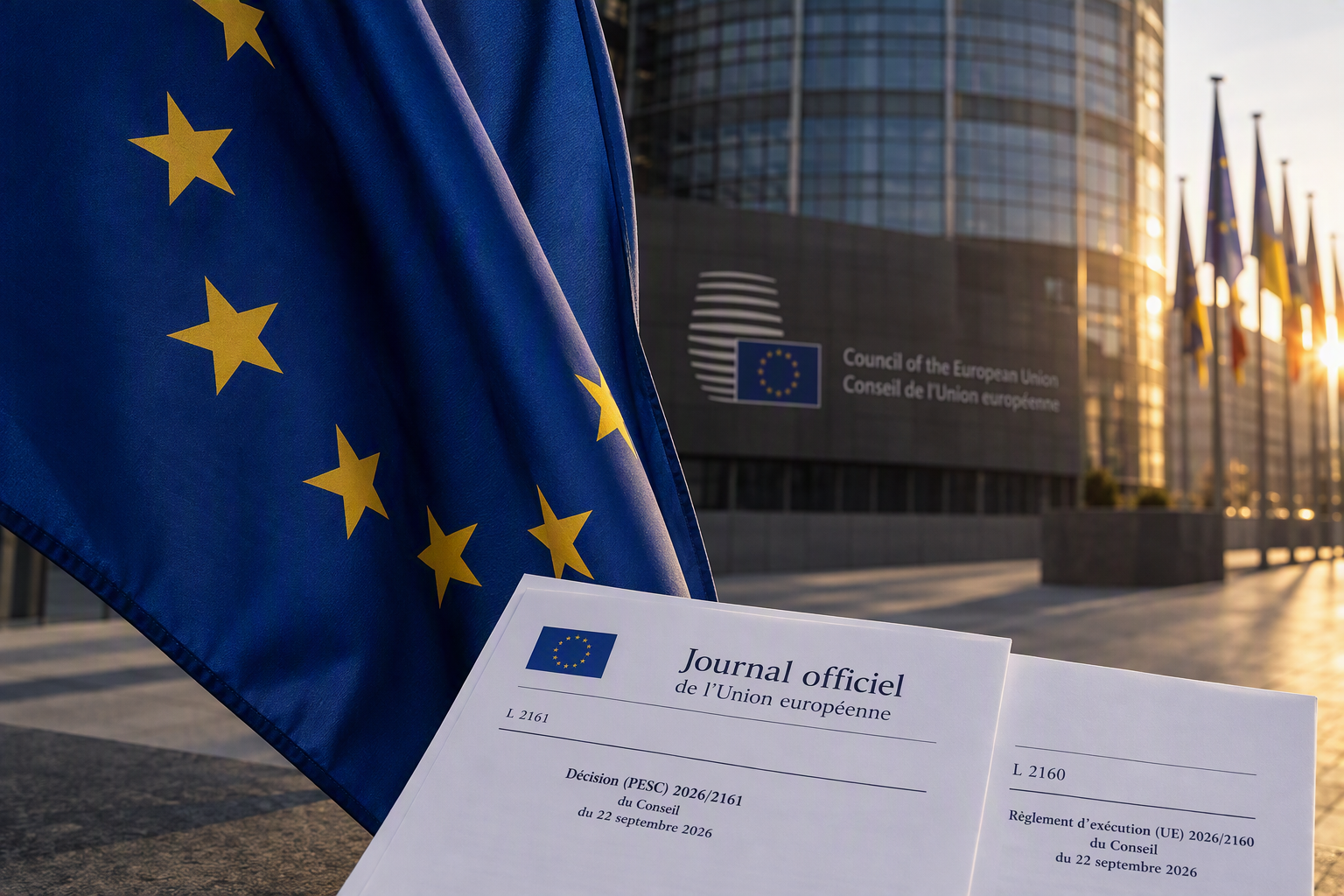
On 22 September 2026, a few hours before the regime was due to expire, the Council extended the individual restrictive measures adopted under the Ukraine territorial integrity regime. Two acts were published that same day in the Official Journal of the European Union: Decision (CFSP) 2026/2161, amending Decision 2014/145/CFSP, and Implementing Regulation (EU) 2026/2160, implementing Regulation (EU) No 269/2014.
The extension runs for thirty-six months, until 22 September 2029. It covers more than three thousand persons and entities, subject to the freezing of assets, to the prohibition on making funds and economic resources available and, for natural persons, to restrictions on admission to the territory of the Union. Following the review, the Council decided not to renew the listing of three persons and one entity, and to remove from the list three deceased persons.
Two developments should be distinguished: one concerns the content of the list, the other is related to the tempo of its extension. The second is by far the most structural.
The Chronology of a Deadlock
The previous cycle had been opened by Decision (CFSP) 2026/696 of 14 March 2026, which extended the individual measures by six months, that is until 15 September 2026. On that day, the Committee of Permanent Representatives failed to reach the unanimity required by Article 29 of the Treaty on European Union (“TEU”). Rather than let the regime lapse, the Council adopted Decision (CFSP) 2026/2103 of 15 September 2026, which does no more than replace the date in the second subparagraph of Article 6 of Decision 2014/145/CFSP with that of 22 September 2026. Recital (4) openly acknowledges the function of that act: to allow time for an “orderly and carefully considered” review.
A technical seven-day extension for a regime in force since 2014: the act is brief, but it says a great deal about the state of the consensus.
The friction point had long been identified. For several cycles Slovakia had been seeking the delisting of Alisher Usmanov and Mikhail Fridman. Bratislava’s position would not have sufficed, and it was therefore the support of France, invoking a national security interest and an collective operation with “international partners”, that shifted the balance of power, to the great surprise of the other delegations. Luxembourg went further on the case of Fridman, who has brought arbitration proceedings against the Grand Duchy quantified at fifteen billion euros. Latvia, two weeks away from parliamentary elections, caused the agreement in principle reached on the Monday to collapse, before resorting to abstention so as not to trigger the lapse of the regime as a whole. Agreement was finally secured by written procedure on the evening of the 22nd.
Things must be called by their name: the legal architecture of the regime, namely the unanimity requirement for adopting individual sanctions, combined with a sunset clause with closely spaced expiry dates, gave each Member State, every six months, leverage whose exchange value far exceeds the subject matter of the vote. The removal of one name becomes the price of maintaining three thousand others.
What Must Be Inferred from the Council’s Press Release
The Council’s press release remains sober: it states the number of delistings, namely three persons and one entity, plus three deceased persons, but discloses no identity. It was the press that reported the names of Alisher Usmanov, Mikhail Fridman and Andrei Falaleev.
It must therefore be recalled at this stage that a press release is not a source of enforceable positive law. The delistings are to be inferred from the annex to Implementing Regulation 2026/2160, by comparison with the earlier consolidated version of Regulation 269/2014. That comparison, and that comparison alone, makes it possible to establish with certainty which entries have disappeared from Annex I, and therefore which freezing measures must be lifted.
Two clarifications are required as to the scope of the move. First, a delisting does not mean that the initial listing was unlawful: the Council decides not to renew, but it does not acknowledge having wrongly designated. Second, the removal of three deceased persons is mere cleaning of the list, which does not have any political significance: it is mentioned in the same paragraph as the negotiated delistings, which has the effect of blurring the picture.
From Six to Thirty-Six Months
This is the genuine legal novelty of this cycle, and it is considerable.
The mechanics of the Union’s restrictive measures rest on a pair of acts: a CFSP decision, adopted unanimously on the basis of Article 29 TEU, which carries the expiry clause; and a regulation adopted on the basis of Article 215 of the Treaty on the Functioning of the European Union (“TFEU”), which gives direct effect to the asset freeze in the legal order of the Member States. Since 2014, the expiry clause in Article 6 of Decision 2014/145/CFSP had been renewed every six months. It is now renewed for three years.
This move is not an isolated one. In June 2026, the Member States had already extended the duration of the sectoral sanctions to one year, precisely in order to reduce the number of opportunities for bargaining by certain Member States. What was done for economic sectors has been extended to individual measures, with a longer time span.
In terms of the effectiveness of the regime, the gain is obvious: five renegotiation deadlines are removed over three years. The leverage constituted by the six-monthly expiry disappears, and with it the ability of an isolated Member State to trade its vote. The predictability of the regime, for operators and national authorities alike, is considerably strengthened.
But the efficiency gain is paid for elsewhere, and this is where the analysis must be thorough.
What the New Tempo Changes for Listed Persons
The expiry clause and the obligation of periodic review of listings are not one and the same. The former conditions the very existence of the regime; the latter is a procedural guarantee attached to each individual designation, which the case-law of the General Court of the European Union treats as a component of the rights of the defence and of the right to effective judicial protection. Extending the former does not abolish the latter.
The fact remains that, during the past four years, the two exercises were conducted together. The six-monthly review of the list was the occasion, for each listed person, to submit observations and to obtain from the Council a justified answer on the maintenance of their designation. It was also the occasion, for the Council, to update the statements of reasons and to purge listings that had become indefensible. Three years is an interval of a different nature: the situation of a natural person may have changed entirely (cessation of duties, selling of shareholdings, departure from Russian territory, etc.) without the regime offering any natural and fixed occasion to draw the consequences.
The question raised is therefore not that of the lawfulness of the extension, which is hardly doubtful, but that of its interplay with the thoroughness of the review. A review whose formal deadline recedes must, in order to remain effective and respectful of fundamental freedoms, be accompanied by increased responsiveness from the Council to individual requests for review submitted outside the calendar. Failing that, the gap between the guarantee on paper and the guarantee in practice will become a serious argument before the General Court.
The Effect on Restrictive Measures Litigation
This is probably the most underestimated impact of the reform, and it cuts both ways.
Under the six-monthly tempo, each maintaining act constituted a separate challengeable act within the meaning of Article 263 TFEU, opening a fresh two-month period for initiating proceedings. This gave rise to a well-known litigation practice: the listed person brought an action against the initial act, then an action, or a statement of modification, against each successive maintaining act, failing which the listing would be consolidated by an uncontested act even if the initial act were annulled. The Fridman case is the clearest illustration: the General Court held in 2024 that the grounds were insufficiently substantiated for the periods covering 2022 and 2023, without that entailing the disappearance of the listing, which was maintained by subsequent acts unaffected by the annulment.
The move to thirty-six months profoundly alters this system. On the one hand, it eases the procedural burden: no more statements of modification every six months, and a substantive reduction in the cost and complexity of litigation for applicants and for the Registry of the General Court alike. On the other hand, it considerably raises the stakes of the time limit. The two months following publication on 22 September 2026 open a window of opportunity that will not reopen before 2029. An applicant who lets that time limit pass risks remaining listed for three years with no challengeable act, the only residual route being a request for review addressed to the Council, followed by an action against the refusal, which is a longer path whose effectiveness is less assured.
The immediate practical consequence for counsels to listed persons is that the timeline management becomes critical. Waiting for the next cycle in order to refine a litigation strategy no longer has any purpose, since there will be no next cycle for three years.
The Scenario of Non-Renewal
The renewal a few hours before the deadline induces the question that everyone is avoiding: what would have happened at midnight on 23 September had no agreement been reached?
The journalistic reading is straightforward: banks would have had to unfreeze overnight the accounts of several thousand sanctioned Russian persons and companies, and the travel bans would have ceased to produce effect. That presentation correctly captures the economic stakes, but it oversimplifies the legal mechanism.
To understand what would actually have happened, it must be borne in mind that the regime rests on two texts, not one.
The first is Decision 2014/145/CFSP. It is the political act: it expresses the will of the twenty-seven, and it alone carries an expiry date, in Article 6. The second is Regulation 269/2014. It is the operational act: it directly requires banks and undertakings to freeze assets, and it is its Annex I that contains the list of names. That second text has no expiry date.
Expiry would therefore have affected the decision alone. The regulation would have remained formally in force, and the names listed in its Annex I would have remained there. A list does not erase itself, and an act is required to remove an entry from it.
The difficulty is that the two texts are linked. Article 215 TFEU allows a sanctions regulation to be adopted only where there is an underlying CFSP decision. By disappearing, the decision would therefore have deprived the regulation of its legal basis, without repealing it or emptying its list.
The result would have been a situation with no clear way out: a regulation still applicable, but whose legal basis would have been open to challenge; and listings still in force, which only a new act of the Council could have lifted. Yet that same Council had just failed to reach unanimity. The deadlock that would have caused the expiry would therefore, in all likelihood, also have prevented another consensus.
The intermediary period would thus be legally unstable, and it is precisely that instability which is feared by professionals. Regulated entities would be faced with an equally uncomfortable alternative: maintaining freezing measures whose legal basis is contested, thereby exposing themselves to liability claims and to restitution demands with interest; or lifting them, thereby exposing themselves to a retroactive reinstatement of the regime and to challenges to their compliance framework. Neither limb is a tenable position.
It is that prospect, rather than attachment to three names, which explains the Latvian abstention. It also explains, in retrospect, the logic of the calendar reform: reducing the frequency of the deadlines means reducing the frequency with which this scenario has to be averted in extremis.
Measures to Be Carried Out
For financial institutions, asset managers and exporting operators, this cycle calls for precise and dated verifications.
- Update screening databases on the basis of Implementing Regulation 2026/2160, identifying the entries removed from Annex I by comparison with the earlier consolidated version of Regulation 269/2014.
- Document the lifting of the freezing measures relating to the delisted entries: effective date, legal basis, treatment of funds and accrued interest, and information of the client. The lifting must be as traceable as the freeze was.
- Do not extend the delisting beyond its scope. A person removed from Annex I to Regulation 269/2014 may remain targeted by other regimes, such as the sectoral sanctions under Regulation 833/2014, OFAC or OFSI designations, or national measures.
- Re-examine ownership and control analyses in which a delisted person appeared as ultimate owner: the delisting may release the freeze on owned structures, but that conclusion requires an entry-by-entry verification.
- Indicate the new 2029 deadline into internal review procedures.
Additional Points of Vigilance
The calendar of listings and that of delistings no longer coincide. The extension runs until 2029, but the Council retains the power to add persons and entities at any time by way of an implementing regulation, as it has done on several occasions during 2026. The three-year tempo is that of the expiry of the regime, not that of its updating. Any interpretation deducing from that a stability of the list itself would be mistaken.
One question, finally, is left open by this cycle. By agreeing to delist persons whose listings had been defended before the General Court, the Council creates a precedent that applicants will not fail to seize upon: if a designation can be abandoned on grounds relating to the bilateral relations of a Member State, the consistency of the designation criteria and the robustness of their judicial review are called into question. Usmanov’s pending appeal before the Court of Justice may provide an opportunity to measure the scope of that development.